What Size Door Hinge Do I Need? Quick Answer
For most standard commercial doors, the answer to what size door hinge do I need is a 4-1/2-inch by 4-1/2-inch hinge. That size is commonly used on 1-3/4-inch-thick hollow metal and solid-core wood doors. For many residential interior doors, a 3-1/2-inch by 3-1/2-inch hinge is typical, while heavier entry doors often use 4-inch or 4-1/2-inch hinges.
Hinge size is only part of the decision. Door thickness, height, width, weight, frequency of use, fire rating, frame material, and required clearance all affect the correct selection. A standard-size hinge can still fail if it is too light for the door or if the wrong bearing type is used.
| Door Type | Typical Door Thickness | Common Hinge Size | Typical Quantity |
|---|---|---|---|
| Residential interior door | 1-3/8 inches | 3-1/2 x 3-1/2 inches | 2 or 3 |
| Residential entry door | 1-3/4 inches | 4 x 4 or 4-1/2 x 4-1/2 inches | 3 |
| Standard commercial door | 1-3/4 inches | 4-1/2 x 4-1/2 inches | 3 |
| Heavy or high-traffic commercial door | 1-3/4 inches or more | 4-1/2 or 5 inches, heavy-weight | 3 or more |
| Door over 7 feet tall | Varies | Based on thickness and weight | 4 or more |
Why Door Hinge Size Matters
Choosing the correct hinge size is essential because the hinges carry the door’s weight, control its alignment, and allow it to swing without binding. Undersized hinges can cause the door to sag, drag across the floor, rub the frame, misalign at the latch, or wear out prematurely.
If you are asking what size door hinge do I need, do not base the decision on height alone. Two hinges can both measure 4-1/2 inches tall but have different leaf widths, material thicknesses, bearings, fastener patterns, and load capacities. The correct hinge must fit the door and frame while also supporting the application.
Door hinge problems often show up gradually. A door may operate correctly when first installed, then begin to squeak, sag, or require lifting to latch. Many of these issues are caused by selecting a hinge that is the wrong size, wrong weight class, or wrong type for the door.
How Door Hinges Are Measured
Butt hinges are measured while fully open and laid flat. The first dimension is the hinge height, measured from top to bottom. The second dimension is the total open width, measured across both leaves from one outside edge to the other.
For example, a 4-1/2-inch by 4-1/2-inch hinge is 4-1/2 inches tall and 4-1/2 inches wide when open. Each leaf is not necessarily exactly half of that width because the hinge barrel and knuckle geometry affect the measurement.
- Height: The vertical dimension from the top to the bottom of the hinge.
- Open width: The full horizontal dimension across both leaves with the hinge flat.
- Leaf width: The width of one hinge leaf from its edge to the barrel.
- Gauge: The thickness of the hinge metal.
- Corner style: Square, 1/4-inch radius, or 5/8-inch radius.
- Hole pattern: The arrangement and location of the screw holes.
When replacing an existing hinge, match all of these details. A hinge with the correct height but the wrong corner radius or screw pattern may not fit the existing mortise.
Door Hinge Size by Door Thickness
Door thickness is the starting point for answering what size door hinge do I need. A wider hinge is required as the door becomes thicker so the barrel projects far enough beyond the face of the door and frame to allow proper swing clearance.
| Door Thickness | Common Hinge Height | Common Open Width | Typical Application |
|---|---|---|---|
| 1-1/4 inches or less | 3 inches | 3 inches | Light cabinets and small utility doors |
| 1-3/8 inches | 3-1/2 or 4 inches | 3-1/2 or 4 inches | Residential interior doors |
| 1-3/4 inches | 4 or 4-1/2 inches | 4 or 4-1/2 inches | Residential entry and commercial doors |
| 2 inches | 4-1/2 or 5 inches | 4-1/2 or 5 inches | Heavy wood or specialty doors |
| Over 2 inches | 5 inches or custom | Selected for clearance | Oversized, armored, acoustic, or custom doors |
These are common starting points, not universal rules. Door weight, frame construction, and clearance conditions may require a larger or heavier hinge even when the door thickness is standard.
Door Hinge Size by Door Height
If you are still asking what size door hinge do I need, door height tells you how many hinges are required and how the load should be distributed.
Door height primarily affects the number of hinges rather than the height of each hinge. Taller doors place more leverage on the top hinge and require additional attachment points to keep the door aligned.
| Door Height | Typical Number of Hinges |
|---|---|
| Up to 60 inches | 2 hinges |
| Over 60 inches through 90 inches | 3 hinges |
| Over 90 inches through 120 inches | 4 hinges |
| Over 120 inches | Add one hinge for each additional 30 inches or fraction thereof |
Most standard 6-foot-8-inch and 7-foot commercial doors use three hinges. Eight-foot commercial doors typically use four hinges. Extremely heavy doors may require additional hinges even when the height alone would not.
Door Weight and Hinge Weight Class
Hinge height does not tell you how much weight the hinge can carry. Standard-weight and heavy-weight hinges can have the same face dimensions but different metal thicknesses and load capacities.
When deciding what size door hinge do I need for a heavy opening, evaluate both the hinge dimensions and the hinge weight class. A heavy solid-core wood door, lead-lined door, acoustic door, armored door, or oversized hollow metal door may require heavy-weight ball-bearing hinges or a continuous hinge.
- Standard-weight hinge: Suitable for many typical residential and commercial doors.
- Heavy-weight hinge: Made with thicker material for heavier doors and demanding applications.
- Plain-bearing hinge: Best for lighter and lower-frequency openings.
- Ball-bearing hinge: Reduces friction and is preferred for heavier, wider, or frequently used doors.
- Continuous hinge: Supports the door along most or all of its height and improves load distribution.
For more detail on heavier applications, see our guide to the best hinges for heavy doors.
Door Width and Hinge Selection
Wide doors create more leverage on the hinges because the center of gravity is farther from the hinge barrel. A 4-foot-wide door places significantly more stress on the hinges than a 3-foot-wide door of the same height and material.
For wider doors, you may need heavy-weight hinges, ball bearings, a larger hinge, additional hinges, or a continuous hinge. This is especially important when the door is equipped with heavy surface hardware such as a full-size door closer, panic hardware, protection plates, or access-control devices.
Door width also affects the open width of the hinge when the door must clear trim, wall projections, or an adjacent frame. A wider hinge can move the barrel farther away from the frame and provide additional swing clearance.
How to Determine the Correct Hinge Width
The hinge must be wide enough for the barrel to clear the face of the door and frame. If the barrel sits too close to the trim or frame face, the door may bind before reaching its full opening angle.
A simple field check is to measure from the back of the door to the point where the hinge barrel must project beyond the frame or casing. Double that distance and add the barrel allowance. In standard applications, matching the existing hinge width is usually the safest replacement method.
Extra-wide hinges are often used when a door must clear deep trim, wall tile, an applied panel, or another obstruction. Parliament hinges, swing-clear hinges, offset hinges, and pivots may be better than simply increasing hinge width when the clearance condition is unusual.
Common Residential Door Hinge Sizes
For homeowners wondering what size door hinge do I need, the most common answer is 3-1/2 inches for interior doors and 4 inches or more for heavier entry doors.
| Residential Door | Typical Hinge Size | Typical Bearing Type |
|---|---|---|
| Light interior hollow-core door | 3-1/2 x 3-1/2 inches | Plain bearing |
| Solid-core interior door | 3-1/2 or 4 inches | Plain or ball bearing |
| Exterior entry door | 4 x 4 or 4-1/2 x 4-1/2 inches | Ball bearing preferred |
| Heavy wood entry door | 4-1/2 or 5 inches | Heavy-weight ball bearing |
| French door | Based on thickness and weight | Ball bearing often preferred |
Residential replacement hinges also require close attention to corner radius. Many prehung interior doors use either 1/4-inch or 5/8-inch radius corners, while some older doors use square corners.
Common Commercial Door Hinge Sizes
For commercial openings, what size door hinge do I need is usually answered by the standard 4-1/2-inch hinge, but traffic, weight, and door hardware can require an upgrade.
For most standard commercial openings, a 4-1/2-inch by 4-1/2-inch hinge is the expected size. This applies to many 1-3/4-inch-thick hollow metal and solid-core wood doors.
| Commercial Application | Typical Hinge Selection |
|---|---|
| Standard office door | 4-1/2 x 4-1/2-inch standard-weight hinge |
| Door with closer | 4-1/2 x 4-1/2-inch ball-bearing hinge |
| School or hospital corridor door | Heavy-weight ball-bearing hinge or continuous hinge |
| Exterior commercial door | Ball-bearing hinge with corrosion-resistant material or finish |
| Lead-lined or armored door | Engineered heavy-weight hinge or pivot system |
| Eight-foot door | Four properly sized hinges |
If you are choosing hardware for a commercial opening, our broader guide to hinges for doors explains the differences between common hinge types and applications.
When to Use Ball-Bearing Hinges
Ball-bearing hinges are recommended when the door is heavy, wide, frequently used, equipped with a closer, or expected to operate smoothly for a long service life. The bearings reduce friction between the knuckles and help prevent wear.
For most commercial doors with closers, ball-bearing hinges are a better choice than plain-bearing hinges. They are also useful on heavy residential entry doors and any opening where smooth operation is important.
Ball-bearing construction does not change the nominal hinge size. A 4-1/2-inch ball-bearing hinge and a 4-1/2-inch plain-bearing hinge have similar face dimensions, but the ball-bearing version is better suited for higher loads and cycle counts.
When to Use a Continuous Hinge
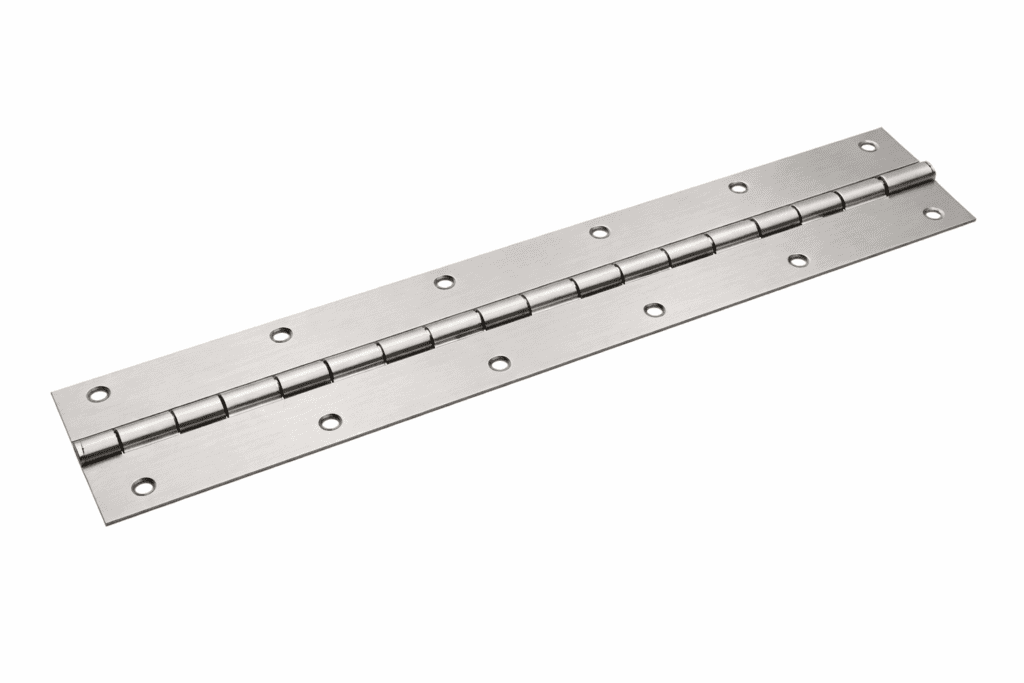
A continuous hinge runs nearly the full height of the door and distributes the load across a much larger area than individual butt hinges. This makes it an excellent option for heavy, abused, or high-traffic doors.
Continuous hinges are common in schools, hospitals, public buildings, retail facilities, and exterior entrances. They are especially useful when repeated sagging has damaged the hinge reinforcements or when the opening must remain aligned under frequent use.
Learn more in our guide to continuous hinges.
Fire-Rated Door Hinge Requirements
Fire-rated doors must use hinges that are appropriate for the listed assembly. The hinge size, quantity, material, bearing type, and fasteners may be governed by the door and frame listing, project specifications, and applicable codes.
Do not replace a hinge on a fire-rated opening based only on appearance. Verify the door label, frame label, hinge type, and project requirements. Spring hinges, pivots, continuous hinges, electrified hinges, and specialty hardware may have specific listing conditions.
A fire door must close and latch properly. If the wrong hinge causes sagging, binding, or misalignment, the opening may no longer perform as intended.
How Many Hinges Do I Need?
The usual rule is three hinges for a standard-height door and one additional hinge for each additional 30 inches of height or fraction thereof. Door weight, width, and use can justify additional hinges.
- Up to 5 feet: Two hinges may be acceptable for light residential doors.
- Over 5 feet through 7 feet 6 inches: Three hinges are typical.
- Over 7 feet 6 inches through 10 feet: Four hinges are typical.
- Over 10 feet: Add one hinge for each additional 30 inches or fraction thereof.
Do not add random hinges to compensate for a damaged frame or undersized hardware. The hinge locations and reinforcements must support the additional hinge.
How to Measure an Existing Door Hinge
- Open the door fully. This gives clear access to the hinge leaves.
- Measure the height. Measure from the top edge to the bottom edge of the hinge.
- Measure the open width. If possible, measure across both leaves with the hinge fully open.
- Check the corner shape. Identify square, 1/4-inch radius, or 5/8-inch radius corners.
- Count and compare screw holes. Match the existing hole pattern.
- Measure the metal thickness. This helps identify standard-weight versus heavy-weight construction.
- Identify the pin style. Determine whether it is removable, non-removable, or security type.
- Check the bearing type. Look for visible bearing housings between the knuckles.
When replacing only one hinge, match the remaining hinges exactly whenever possible. Mixing hinge sizes, gauges, or bearing types on the same door can create alignment and load-distribution problems.
Common Door Hinge Sizing Mistakes
- Measuring only one leaf: Hinge width is measured across both leaves when open.
- Ignoring door weight: A standard-size hinge may still be too light for the door.
- Matching height but not width: The door may fail to clear the frame or trim.
- Using plain-bearing hinges with a closer: This can accelerate wear.
- Ignoring corner radius: The replacement hinge will not fit the mortise correctly.
- Using the wrong screw pattern: New holes can weaken the door or frame reinforcement.
- Mixing standard- and heavy-weight hinges: Uneven geometry can cause binding.
- Using residential hinges on commercial doors: The hardware may be too light for the application.
What Size Door Hinge Do I Need for a Replacement?
For a direct replacement, use a hinge that matches the existing height, open width, metal thickness, corner style, screw pattern, bearing type, pin type, material, and finish. If the existing hinge failed because it was undersized, do not simply install the same part again.
When upgrading to a larger or heavier hinge, verify that the door and frame have adequate reinforcement and that the new hinge will fit the mortises. Commercial hollow metal doors and frames often contain internal hinge reinforcements designed for specific hinge sizes and screw patterns.
Our guide to replacing door hinges explains the replacement process in more detail.
Frequently Asked Questions
What size hinge is used on a standard commercial door?
Most standard 1-3/4-inch commercial doors use 4-1/2-inch by 4-1/2-inch hinges. Ball-bearing hinges are commonly preferred when the opening has a closer or receives frequent use.
What size hinge is used on a residential interior door?
Many 1-3/8-inch residential interior doors use 3-1/2-inch by 3-1/2-inch hinges. Some lighter or older doors may use 3-inch hinges.
Can I use a 4-inch hinge on a 1-3/4-inch door?
A 4-inch hinge may work on some residential 1-3/4-inch doors, but 4-1/2-inch hinges are the standard choice for most commercial 1-3/4-inch doors. Door weight, width, use, and clearance should also be considered.
When should I use a 5-inch hinge?
Five-inch hinges are used for thick, heavy, wide, or high-use doors and where extra hinge width is needed for clearance. The door and frame must be prepared for the larger hinge.
Do heavier doors need larger hinges?
Not always larger in face dimensions, but they often need heavy-weight construction, ball bearings, additional hinges, or a continuous hinge. Load capacity is just as important as nominal size.
How many hinges does an eight-foot door need?
An eight-foot door typically uses four hinges. Additional support may be required for unusually heavy or wide doors.
Are all 4-1/2-inch hinges the same?
No. They can differ in width, gauge, hole pattern, corner style, bearing type, pin type, material, finish, and load capacity.
Should exterior doors use ball-bearing hinges?
Ball-bearing hinges are a good choice for heavy exterior doors and doors equipped with closers. Corrosion resistance is also important in exterior or damp locations.
Can I replace one hinge without replacing the others?
Yes, if the replacement exactly matches the others and the remaining hinges are in good condition. Replace the full set when the hinges are worn, mismatched, or being upgraded to a different weight class.
What is the best hinge for a high-traffic door?
Heavy-weight ball-bearing hinges or a continuous hinge are common choices for high-traffic openings. The best option depends on door weight, width, frequency of use, frame condition, and project requirements.
Final Answer: What Size Door Hinge Do I Need?
For most standard commercial doors, use three 4-1/2-inch by 4-1/2-inch hinges on a 1-3/4-inch-thick door up to approximately 7 feet tall. Choose ball-bearing hinges when the door is heavy, frequently used, or equipped with a closer.
For most residential interior doors, 3-1/2-inch by 3-1/2-inch hinges are common. Exterior and heavy residential doors often require 4-inch or 4-1/2-inch ball-bearing hinges.
The complete answer to what size door hinge do I need depends on door thickness, height, width, weight, use, clearance, frame construction, fire rating, and hinge type. Match all dimensions and performance requirements rather than selecting a hinge by height alone.